
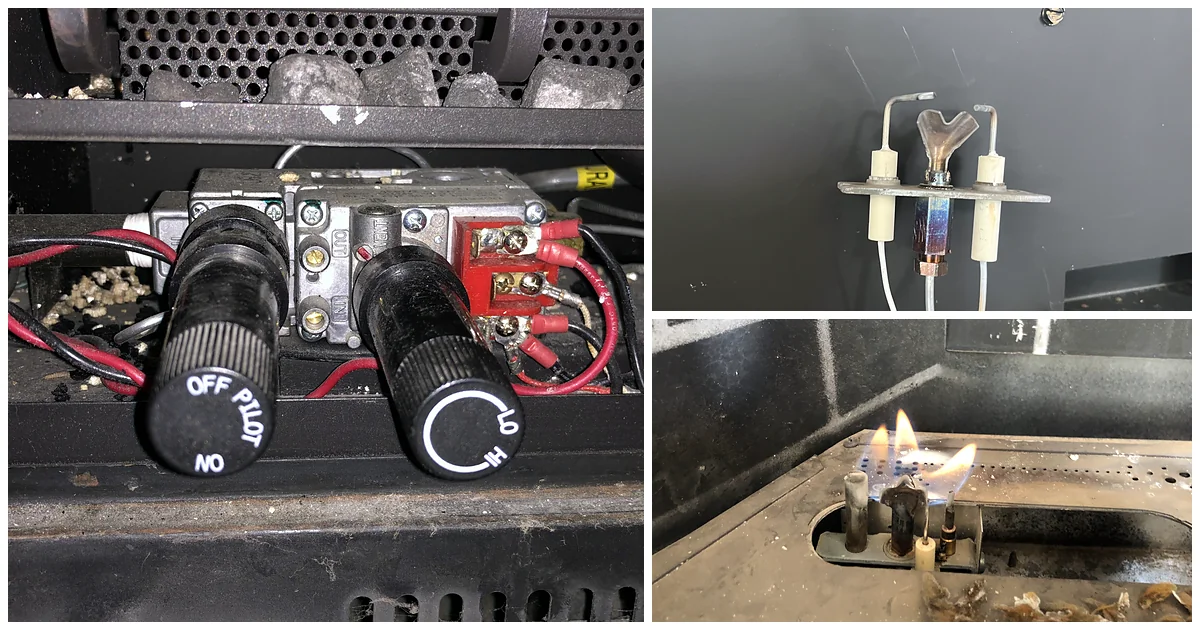
A gas fireplace that won’t light on a cold evening is frustrating. Sometimes the fix is as simple as a remote battery or a control setting. Other times, the ignition system, gas controls, or safety components need testing by a technician.
Here’s what you can safely check yourself, what to leave alone, and when to call us. One rule runs through all of it: follow the owner’s manual for your exact model. Two fireplaces can have similar controls and very different lighting steps.
Safety first
If you smell gas or hear hissing near gas equipment, leave the house first. Don’t light anything, flip switches, unplug anything, or use your phone inside. Once you’re outside and away from the house, call 911, then your gas utility or propane supplier. Stay out until they tell you it’s safe.
If a carbon monoxide alarm goes off, get everyone outside to fresh air and call 911. Don’t look for the source, and wait for responders to say it’s safe to go back in.
If your fireplace has delayed ignition, meaning a pause followed by a bang or a loud “whoosh,” stop using it and schedule service. Don’t keep restarting it, adjust the gas controls, or move the logs to try to fix it.
Start with your model’s manual
If there are no warning signs, find your owner’s manual. The model information is usually in your paperwork or on the rating label. If you can’t reach the label easily with the fireplace off and cool, leave it and just let us know when you call.
Your fireplace and its remote may have separate manuals, and you’ll want both. Heat & Glo, for example, has separate owner guidance for standing pilots, battery backup, and several remote systems. Follow your own instructions, not a generic reset from the internet.
Check the remote and the basic controls
With the fireplace off and cool, replace the remote batteries the way the manual describes, using the right type and facing the right way. Some fireplaces also have a receiver or a backup battery pack. Only change those if your manual calls it a homeowner task and you can reach them without taking anything apart.
Next, look at the normal settings. A thermostat mode, timer, or receiver setting can keep the fireplace from responding. Leave unfamiliar switches and wiring alone.
If your model needs household power, check for an outage or a tripped breaker. Don’t keep resetting a breaker, and don’t reach into the fireplace to test an outlet. The blower and the ignition can be powered differently, so a quiet fan doesn’t mean the ignition has lost power.
Look at the pilot, but don’t work on it
Standing pilots and intermittent pilots behave differently. An intermittent pilot may only light when the fireplace calls for heat, so seeing no flame at rest isn’t necessarily a problem.
Look only through the normal viewing area. No removing the glass, cleaning the pilot, probing the burner, or using a match or lighter to force ignition. If your manual includes a homeowner lighting procedure, follow it exactly, including the waiting periods. If it doesn’t work, or you’re not sure, stop there and call for service instead of trying again.
A pilot that won’t stay lit, clicking with no flame, or a burner that shuts off on its own all need a closer look. They’re worth sharing, but they don’t tell you which part failed.
Leave the gas supply to the pros
If a utility outage is possible, check your utility’s outage updates. Don’t light another gas appliance to test the supply, open a closed gas valve, or change pressure settings. If a valve is closed, someone may have shut it on purpose.
When you call, tell us about any recent utility work, service interruption, remodeling, water getting in, or past repairs. If an error message came up, write it down rather than trying to make it happen again. Those details help us get to the answer faster.
Who comes out
Every fireplace visit is handled by Eric, our NFI Certified Gas Specialist. You can verify NFI certification at nficertified.org. Every service and cleaning includes a full safety check, and part of it is a sweep of the fireplace for carbon monoxide (CO) and combustible gas leaks, including methane (CH4, the main component of natural gas) and propane. Learn more about our fireplace service and repair.
Get a clear next step
If the batteries and settings check out and the fireplace still won’t light, leave it off and schedule a diagnosis. We’ll explain what we find and go over your repair options and costs before any work starts.
For fireplace service in your Front Range home, request service at elevationaandf.com/contact-us/, text 303-625-7464, or call 303-591-2978. Have your model number handy, plus a quick note about what the fireplace is doing.
Official sources
- Heat & Glo official owner care resources
- Heat & Glo owner manual library
- Heat & Glo Cosmo-SXT-IPI / Cosmo-GXT-IPI manual, page 20
- Heat & Glo FB-IN-S / FB-GRAND-S manual, pages 1, 17–19, 32–34
- Xcel Energy Natural Gas Safety (Colorado)
- CPSC CO fact sheet
Sources checked October 21, 2026. Refer to the documentation for your exact appliance model.